

What Is the Difference Between Poker and Blackjack?
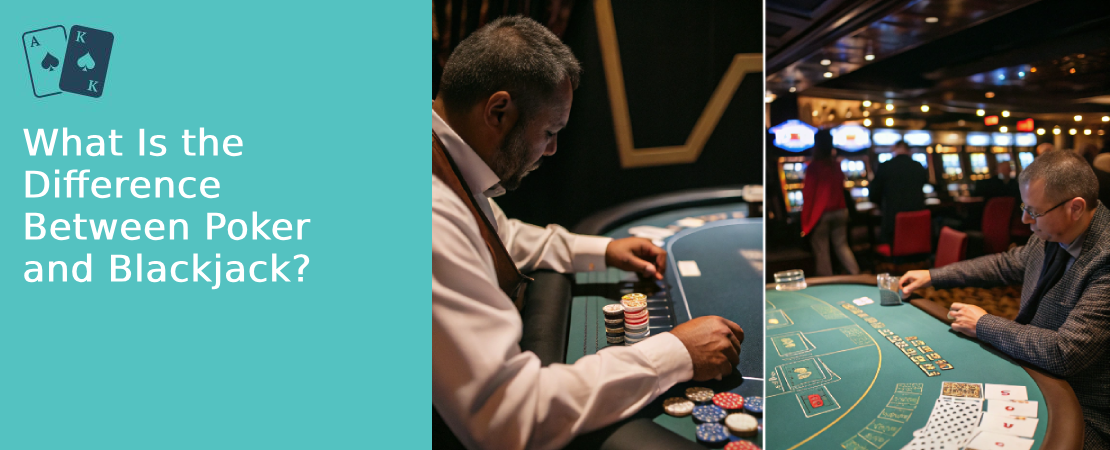
While being located in close proximity within a casino, poker and blackjack share contrasting views about what makes card games exciting. While one perfectly reflects the math-based fight against the house, another represents an endless struggle between the human mind and the cruelty of the odds. Understanding the differences between the purposes, edges and general approach that goes into each game is key for choosing where to put your personality and money.
The Core Question in Blackjack: Can You Beat the House?
In essence, Blackjack is a battle between yourself and the house. It’s an exciting game that takes less than a minute per hand. The only competitor that you have in this game is the casino itself. As it’s all about reaching the sum of 21 points and not busting, this fast-paced game is basically a mathematical test.
If you’ve been mainly indulging yourself with the dynamic gameplay offered by NZ online slots, you might experience some difficulties adapting to the game of cards. In Blackjack, payouts for each winning combo are fixed and known upfront. With Texas Hold’em poker, you need to rely on the skills of forming winning hands from five community cards or bluffing others out of their bets. This game doesn’t come with paytables and is all about a pot of chips.
Dynamics of Skill versus Luck
Because the dealer has to use certain forced rules, the game of blackjack becomes totally solvable. In other words, basic strategy will help get maximum gains for all possible situations with regard to the player’s total hand and his exposed cards; as a result, mastering basic strategy becomes an essential way to make decisions subconsciously and to reduce the house edge as close to zero as possible. Edge players using card counting and even more sophisticated methods will earn minimal amounts of money, which will be hard to preserve in view of existing counter-methods.
Poker, on the other hand, makes the expectation equation entirely dependent on the human player himself. The casino charges only a small fee for running the game. The expectation factor here depends entirely on the skills possessed by the poker players. As the number of dealt hands grows into thousands, range construction, bet sizing, and reading opponents become an efficient way to generate earnings. While luck might win all day long, many scientific works prove that after about 1500 hands, the skill factor comes first. To be more clear, while the best player in the game of blackjack tries to decrease losses, the best poker player makes a profit.
House Edge and Economic Model
Firstly, the house edge in online blackjack is established directly in its rules. Thus, it includes such aspects as uneven payouts in case of naturals on 6:5 tables, the last action of dealers, and limitations concerning doubling and splitting. No matter how perfectly a player plays by using basic strategy, he still loses some money. Depending on the number of decks, payout ratios, and the surrender rule availability, the house edge varies in a relatively narrow band but always stays in favor of the casino.
Speaking about economics in poker, a casino does not participate in games and takes only a relatively small commission for each cash game or a fixed buy-in for each tournament. This feature makes skilled poker players compete against one another. When the winning rate is higher than the rake, a player can obtain sustainable profits. Since there is no direct competition between casinos and players, there is no motivation to limit the way they analyze poker situations offline. However, most poker sites prohibit RTA tools online.
Structure of Information and Complexity of Decisions
When it comes to visible information, there is hardly a better card game than blackjack. The only hidden information here is the hole card of the dealer, which is revealed at the end. Given the lack of uncertainty in the game, there are relatively small decision trees involved. It is easy to tabulate expected values of different options like hit, stand, double down, split and surrender, with there being an unambiguous answer for each position in the game. Thus, once a person memorizes the chart, their decisions start resembling some kind of routine.
By concealing the hole cards of its opponents and dividing community cards into different streets, poker makes players deal with complex decision trees that cannot be enumerated. Not only does the information structure make players estimate their opponents’ ranges and weigh their pot odds, but it also does so in the midst of constantly growing stack sizes. As a result, the complexity of decision trees depends on the number of people and the stack sizes in an exponential manner.
Psychological Factors
While multiple people can sit together at the blackjack table, they do not compete against each other. In fact, interaction between people playing at a single table is usually confined to mutual dissatisfaction when someone takes “the dealer’s bust card” with a hit. These episodes have nothing to do with the expected value in the long run as a perfect strategy does not depend on the mistakes of other players.
Psychology plays a key role in poker games. Being able to read betting behavior, control oneself through variance, and create a good image, so that extra folds come from it, significantly increases the profit. While bluffing cannot be applied to blackjack, in poker a person should convince other players using their chips to represent a non-existent hole card in order to win the game.
Variance and Bankroll Management
As was said above, variance in blackjack is rather small. Having played with a flat bet using the optimal basic strategy, the player will easily predict possible losses and wins on an hourly basis. Besides, there is a small standard deviation. Therefore, the only thing he/she has to do is simply calculate the average losses and determine the amount of money to play with during the whole gaming session.
On the contrary, poker variance can become tremendous because of the pot size increase and the appearance of a statistical advantage only after thousands of hands dealt. Therefore, even a great poker professional can lose money for weeks playing optimally, whereas an ideal bot of blackjack can never suffer from a prolonged losing streak. That is why bankroll management in poker requires huge amounts of money (even 100 buy-ins) because without that, one would risk losing his/her money completely and developing bad habits because of it.
Legal and Ethical Considerations
Regulatory bodies consider blackjack a game of chance with a definite house edge. Even card counting does not make this game skill-based because it is still considered advantage play, which gives casinos an option to refuse players from entering their establishments.
However, the poker law-making process is more complicated and uses the concept of the dominant factor or material element test to decide whether a certain game involves skills or luck. Modern tendencies in courts prove the necessity of certain skills required to play successfully in the long run. As a consequence, this interpretation has brought poker much improvement like poker tournaments on television, online play legalization, and sponsorship.